


National Geographic 1999 March
Publisher: National Geographic
Format: Paperback
ISBN: none
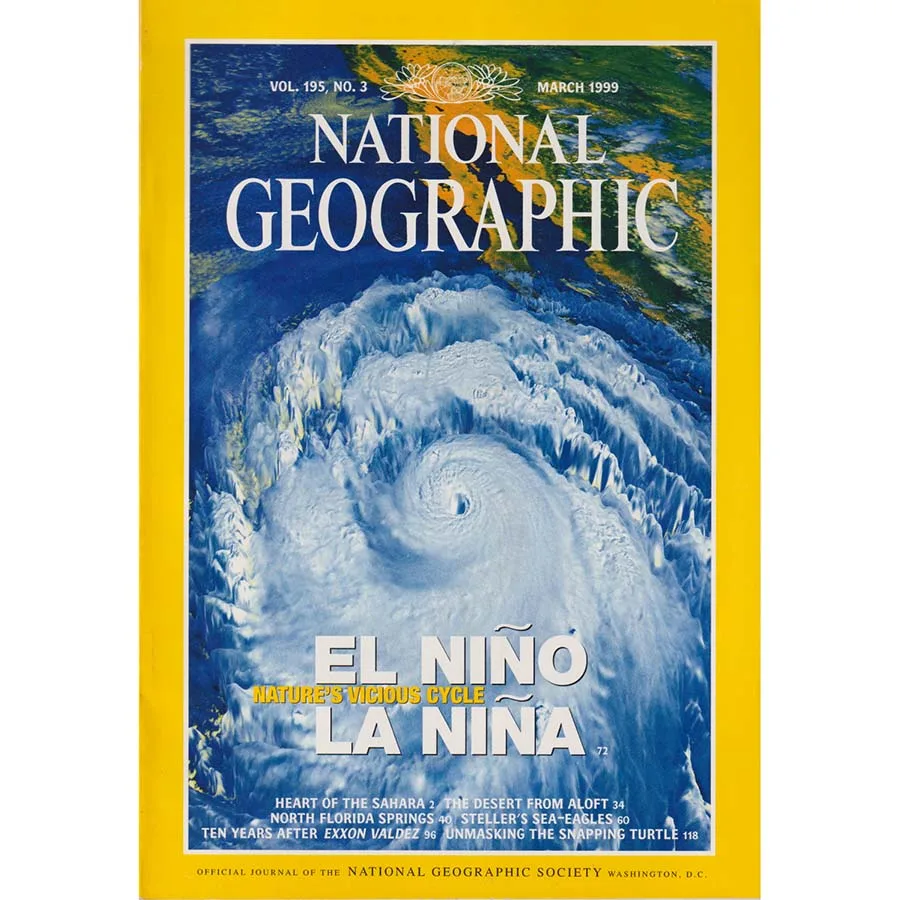
Welcome to National Geographic, March 1999 (Vol. 195, No. 3) — the issue that looks you dead in the eyes and says: You think you understand weather? That’s adorable.
The cover is a gigantic, swirling satellite view of atmospheric drama, paired with the perfectly understated headline: EL NIÑO / LA NIÑA — Nature’s Vicious Cycle. Which is National Geographic’s way of describing a planet-scale system that rearranges rainfall, storms, harvests and headlines… as if it’s an awkward relationship you can “work through” with a bit of communication and a laminated diagram.
This is peak late-90s Nat Geo: big science, big photography, and that calm, authoritative tone that makes even chaos feel orderly — like if you just read carefully enough, the hurricane will apologise and move along. The feature on El Niño and La Niña is the kind of deep dive that turns dinner-party small talk into a lecture you didn’t know you wanted to give. (“Actually, it’s coupled ocean–atmosphere variability…”) You’ll finish it with the smug satisfaction of a person who can now blame the Pacific for half of life’s inconveniences.
But of course, National Geographic cannot resist variety, so once it’s spun you around the planet’s climate engine, it switches gears and hands you the rest of the world like a sampler platter:
-
Heart of the Sahara — because after learning that the ocean can rewrite your weather, why not visit a place where the land looks like it’s been stripped down to its most honest form: heat, sand, and astonishing scale.
-
The Desert from Aloft — aerial views that make the Earth look like abstract art, and make you question why you own so many unnecessary objects.
-
North Florida Springs — a refreshing plunge into clear water and hidden ecosystems, essentially the magazine saying, “Here, have a palate cleanser before we return to catastrophe.”
-
Steller’s Sea-Eagles — enormous, dramatic birds that look like they were designed by someone who thought “regular eagle” was too subtle.
-
Ten Years After Exxon Valdez — the sobering follow-up that reminds you nature is resilient, but not a doormat.
-
Unmasking the Snapping Turtle — an animal that has never once considered being approachable, and frankly shouldn’t have to.
Condition: Good, which is exactly right for a magazine that’s meant to be read, pored over, left open on the table, and used as evidence that you are the sort of person who casually reads about climate oscillations and apex reptiles. It’s pre-loved, still handsome, and still perfectly capable of making you stare at clouds with suspicion for the next week.
If you want a single issue that combines:
planetary-scale weather mischief, deserts that look like paintings, birds that could carry your regrets away, and a turtle that would absolutely win in an argument,
then March 1999 is your yellow-bordered delight — sold, naturally, by Crappy Old Books, where yesterday’s world-class journalism goes to live its best second-hand life.
Keep browsing: See more National Geographic books Other books by National Geographic
